Truck accidents in Colorado Springs can have devastating consequences, leaving victims with severe injuries, mounting medical bills, and emotional trauma. Given the city's bustling roadways and proximity to major highways like I-25 and Highway 24, the risk of such accidents is ever-present. If you or a loved one has been involved in a truck accident in Colorado Springs, it's crucial to understand your rights and the steps you can take toward recovery.
At
Pribila and Fields, we are dedicated to providing compassionate and effective legal representation to help you navigate the aftermath of a truck accident.
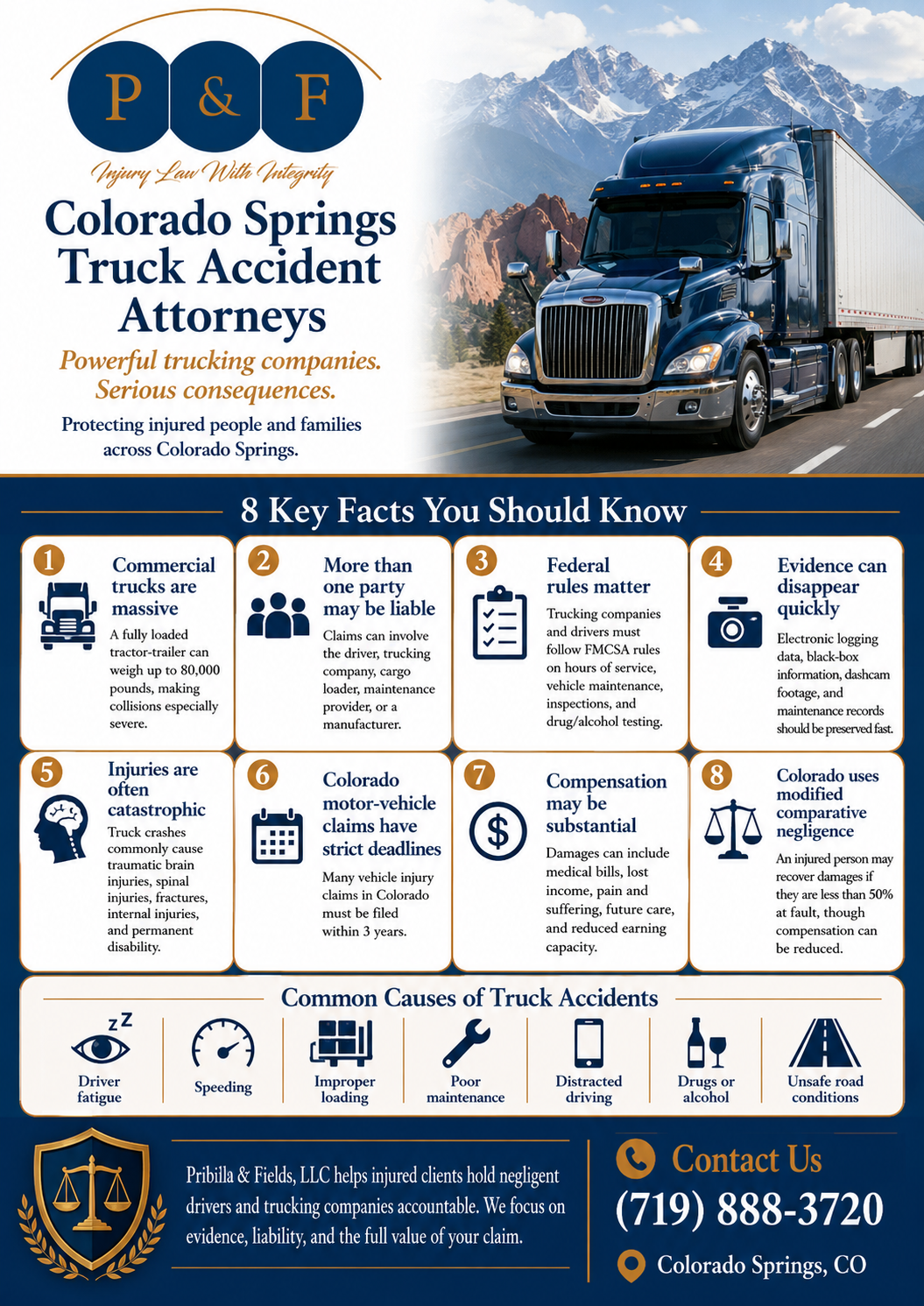
Common Causes of Truck Accidents in Colorado Springs
Truck accidents in Colorado Springs are often more complex and catastrophic than standard car accidents due to the sheer size, weight, and momentum of commercial vehicles. Understanding the most frequent causes can help accident victims, investigators, and attorneys determine liability and develop strategies to prevent future tragedies.
1. Driver Fatigue
Truck drivers frequently face long hauls with tight deadlines, which can result in inadequate rest and chronic fatigue. Federal regulations limit the number of hours a truck driver can be on the road, but some companies and drivers push those limits to meet quotas or delivery schedules.
- In Colorado Springs, driver fatigue is a significant risk factor, especially on heavily trafficked routes like I-25, US-24, and Powers Boulevard.
- Fatigue affects cognitive function, slows reaction time, and impairs judgment—leading to late braking, lane drifting, or failure to avoid obstacles.
A fatigued truck driver behind the wheel of an 80,000-pound vehicle poses a serious threat to all road users in Colorado Springs.
2. Distracted Driving
Despite public safety campaigns, distracted driving remains a major cause of truck accidents in Colorado Springs. For long-haul drivers, distractions can be both physical and mental.
- Common distractions include texting, using GPS devices, eating, adjusting audio controls, and even engaging with dispatch systems.
- The risk is especially high on urban roadways like Academy Boulevard, where truck drivers must navigate stop-and-go traffic, traffic signals, and pedestrian zones.
In a split second, a distracted driver can cause a rear-end collision, sideswipe, or jackknife accident, often with devastating results.
3. Speeding
Speeding significantly increases both the likelihood and severity of a truck accident. Because of their weight and size, commercial trucks require a much longer distance to stop than passenger vehicles. When speeding, drivers reduce their available reaction time and increase their risk of losing control.
- On the open stretches of road outside Colorado Springs, speeding might seem harmless, but it becomes lethal when approaching intersections, merging zones, or congested city traffic.
- In inclement weather—common during Colorado’s winter months—speeding becomes even more dangerous due to slick or icy road conditions.
Speeding trucks are especially hazardous in downtown Colorado Springs, where narrow streets and heavy traffic demand caution.
4. Improper Loading
Federal and state regulations require that cargo be properly loaded and secured before a truck hits the road. Improperly distributed or unsecured cargo can shift suddenly, destabilizing the vehicle and causing it to roll over, jackknife, or spill cargo onto the road.
- In Colorado Springs, improper loading is a key contributor to highway accidents involving commercial vehicles.
- Overloaded trucks can suffer from premature brake failure or tire blowouts—both of which dramatically increase the chance of a crash.
Flatbeds and tanker trucks carrying construction materials, chemicals, or livestock through Colorado Springs must be thoroughly checked for balance and security.
5. Mechanical Failures
Mechanical issues such as brake failure, tire blowouts, steering malfunctions, or lighting system defects can result in serious accidents.
- Trucking companies are legally required to inspect and maintain their fleets, but corners are sometimes cut to save costs.
- In Colorado Springs, where trucks traverse mountain passes and winding roads, even a minor equipment failure can be catastrophic.
These accidents are often preventable and may indicate negligence on the part of the trucking company, maintenance crew, or part manufacturer.
Common Injuries from Truck Accidents
Due to the immense size and force of commercial trucks, accidents often leave victims with life-changing injuries. In Colorado Springs, truck accidents are more likely to cause long-term medical complications compared to standard car collisions. These injuries frequently require hospitalization, surgery, and ongoing rehabilitation.
1. Traumatic Brain Injuries (TBI)
A traumatic brain injury occurs when a sudden blow or jolt to the head disrupts normal brain function.
- Victims of truck accidents in Colorado Springs may suffer TBIs from hitting their head on a dashboard, window, or the pavement during ejection.
- Symptoms include memory loss, impaired cognitive function, difficulty concentrating, mood changes, and even coma.
- TBIs can range from mild concussions to permanent brain damage, with extensive financial and emotional costs.
These injuries often require years of therapy and can impact every area of life, from employment to personal relationships.
2. Spinal Cord Injuries
Injuries to the spinal cord are among the most serious outcomes of truck accidents.
- Spinal cord trauma may cause partial or total paralysis, depending on the location and severity of the injury.
- In Colorado Springs, victims often face limited access to long-term care facilities, making recovery even more challenging.
- Spinal injuries can also lead to chronic pain, loss of motor function, and complications such as infections or respiratory issues.
The financial burden of such injuries is staggering, often exceeding hundreds of thousands of dollars per year in medical expenses alone.
3. Broken Bones and Fractures
High-impact collisions with trucks frequently result in broken bones, especially in the arms, legs, ribs, and pelvis.
- Compound fractures, where the bone breaks through the skin, are common in Colorado Springs accidents involving high-speed crashes or vehicle rollovers.
- These injuries typically require surgical intervention, hardware installation (pins, plates, rods), and months of physical therapy.
For active individuals or those with physically demanding jobs, these injuries can result in long-term disability.
4. Internal Injuries
Internal trauma may not be immediately visible but is just as dangerous.
- Blunt force from a truck crash can rupture organs such as the liver, spleen, or kidneys.
- Victims in Colorado Springs often need emergency surgeries and critical care to stop internal bleeding and prevent organ failure.
Left untreated, internal injuries can become fatal within hours, making immediate medical evaluation critical even when symptoms seem mild.
5. Lacerations and Burns
Sharp metal, shattered glass, and hazardous cargo can cause deep cuts or chemical burns during a truck crash.
- These wounds may require stitches, skin grafts, or reconstructive surgery.
- Burns are particularly common in Colorado Springs when fuel tanks rupture or trucks carrying flammable materials ignite.
Severe lacerations and burns can leave permanent disfigurement, impacting a victim’s self-esteem and mental health.
Our attorneys offer legal representation to injured truck accident victims in Colorado Springs and across the state of Colorado. We also offer our expertise in many other areas of personal injury law, such as:
Who Can Be Held Liable in a Colorado Springs Truck Accident?
Determining who is legally responsible for a truck accident in Colorado Springs is often far more complicated than in standard car accidents. Multiple parties may be involved in the chain of events that led to the collision, and identifying each one is essential for securing the compensation you deserve. An experienced truck accident attorney will conduct a thorough investigation to determine where negligence occurred and who can be held accountable.
Here are the parties that may be held liable in a Colorado Springs truck accident:
1. Truck Drivers
Truck drivers are often the first party considered in any trucking accident. They may be held personally liable if their actions contributed to the crash.
- Common driver-related causes include fatigue (often due to hours-of-service violations), distracted driving (such as texting or eating), driving under the influence of drugs or alcohol, or reckless driving (speeding, tailgating, or unsafe lane changes).
- In Colorado Springs, where traffic congestion and inclement weather create added challenges, driver error is a frequent factor in crashes.
Even when a driver is following directions from their employer, they can still be held responsible for negligent behavior behind the wheel.
2. Trucking Companies
Employers are typically held responsible for their employees’ actions under a legal theory known as respondeat superior. However, trucking companies can also be directly liable if their own negligence contributed to the accident.
- Common failures include negligent hiring (e.g., employing drivers with a record of violations), inadequate driver training, failure to maintain trucks, or encouraging drivers to meet unrealistic deadlines that promote unsafe practices.
- In Colorado Springs, companies that route drivers through busy corridors like I-25, US-24, and Powers Boulevard must ensure their fleets are roadworthy and their drivers are well-prepared.
Trucking companies often have large insurance policies, making them a primary source for compensation in serious injury or wrongful death cases.
3. Cargo Loaders and Shipping Companies
In some cases, third-party cargo loading companies may be responsible for improper loading, overloading, or failing to properly secure cargo.
- Uneven or unsecured loads can cause the truck to shift suddenly, making it unstable and harder to control—especially on steep roads like those near the Front Range or Monument Hill.
- This is particularly relevant for trucks transporting construction equipment, hazardous materials, or livestock through the Colorado Springs area.
These companies can be held liable if improper loading practices contributed to the accident.
4. Vehicle or Parts Manufacturers
Sometimes, accidents are caused by defective parts such as faulty brakes, tires, steering systems, or engine components.
- If the failure of a part directly contributed to the accident, the manufacturer or distributor of the defective component may be held strictly liable under product liability laws.
- In Colorado Springs, where trucks often travel over mountainous terrain, defective brakes or gearboxes can cause fatal downhill crashes.
Identifying a manufacturing defect often requires input from expert engineers and accident reconstruction professionals.
5. Maintenance Providers
Many trucking companies outsource vehicle maintenance to third-party service providers. If a maintenance crew fails to inspect or repair the vehicle properly, they could be held responsible for the crash.
- Examples include failing to replace worn-out brake pads, ignoring bald tires, or neglecting to fix fluid leaks.
- In the Colorado Springs region, where trucks must remain reliable in both hot summers and icy winters, negligent maintenance can be a significant risk factor.
These providers may be liable for accidents caused by their oversight or shoddy workmanship.