(719) 888-3720

Colorado Springs Bicycle Accident Lawyer

Colorado Springs Bicycle Accident Lawyer

Cycling is an increasingly popular way to commute, exercise, and enjoy the scenic beauty of Colorado Springs, from the trails around Palmer Park to the bike lanes downtown. But when negligent drivers fail to share the road, the results can be catastrophic. A bicycle accident in Colorado Springs can leave riders with life-changing injuries, costly medical bills, and an uncertain future.

Speak with a bicycle accident lawyer. Call (719) 888-3720 or request a free consultation with Pribila & Fields about your cycling injury claim.

 
Tim Fields spent more than twelve years as a trial attorney with a major U.S. auto insurer before turning to representing injured Coloradans. That background is relevant when a driver’s insurer disputes fault, injuries or treatment after a bicycle crash. Our attorneys can review the available evidence and explain your options.
 

Common Causes of Bicycle Accidents in Colorado Springs

A bicycle crash may involve a turning vehicle, an opened car door, unsafe passing or a roadway obstruction. Establishing what happened requires evidence about the driver’s actions, the cyclist’s route and the condition of the road at the time.
 
Crash patterns and conditions worth investigating include:
 
 
1. Drivers Failing to Check Blind Spots or Yield When Turning
Many bicycle accidents occur at intersections or while vehicles are turning onto or off of busy streets.
  • Right and left turns present serious risks to cyclists traveling straight in designated bike lanes or shoulders. Drivers may not check mirrors or blind spots before making a turn.
  • These collisions are often described as “right hook” or “left cross” crashes. Preserve the turn direction, lane markings, bicycle route and any video showing the vehicle’s approach.
  • Failure to yield at crosswalks or when entering traffic from driveways or parking lots is another major issue in Colorado Springs.
Cyclists have a legal right to use the road. When drivers ignore their presence or make assumptions about who has the right-of-way, serious accidents follow.
 

2. Distracted Driving

A distracted driver may fail to notice a cyclist, a lane marking or a traffic signal.
  • Even a few seconds of inattention can cause a driver to drift into a bike lane, miss a stop sign, or fail to notice a cyclist crossing the street.
  • Common distractions include texting, adjusting the GPS, eating, changing music, or talking to passengers.
  • Witness accounts, camera footage and the vehicle’s movement may help establish whether inattention contributed to the crash.
Unfortunately, the light profile of a bicycle makes it harder for distracted drivers to notice cyclists in time to avoid a collision.
 
 
3. Dooring
“Dooring” occurs when a parked vehicle’s occupant opens a door into the path of an oncoming cyclist, causing a direct and often unavoidable collision.
  • Colorado Springs has many streets with parallel parking adjacent to bike lanes, particularly in commercial and downtown areas.
  • When drivers or passengers fail to check for oncoming cyclists before opening their door, the cyclist can be thrown from the bike, suffer serious injuries, or be forced into traffic.
  • Victims of dooring incidents often suffer facial injuries, broken wrists, and concussions.
While dooring is preventable with a simple glance, it remains a persistent hazard in the city’s busier corridors and residential zones.
 

4. Speeding or Reckless Driving in Residential or Mixed-Use Areas

Excessive speed reduces a driver’s ability to react quickly to unexpected events, such as a cyclist entering a crosswalk or navigating around parked cars or debris.
  • On a residential street, preserve the posted speed limit and any evidence of the vehicle’s speed before impact.
  • Speeding drivers often misjudge distances or fail to respect the presence of cyclists, especially when no dedicated bike lanes are present.
  • Reckless driving behaviors, such as tailgating, running stop signs, or aggressive lane changes, are particularly dangerous for cyclists due to their exposure and vulnerability.
In mixed-use zones near schools, parks, and shopping centers, the combination of vehicle traffic, pedestrians, and bikes creates a perfect storm for accidents when drivers fail to slow down.
 

5. Poorly Maintained Roadways, Potholes, or Debris in Bike Lanes

Not all bicycle accidents are caused by other drivers; some are due to the road itself.
  • Potholes, cracked asphalt, uneven pavement, and construction debris are especially hazardous for cyclists, whose tires can be easily caught or deflected by irregular surfaces.
  • Photograph any obstruction in the bicycle lane or shoulder, its size and location, and the space available to pass it safely.
  • Wet leaves, gravel, or snow left uncleared from bike routes pose serious skid hazards, particularly in the city’s foothills or after seasonal storms.
Local governments are responsible for road maintenance, and their failure to provide safe cycling surfaces can make them partially liable in an accident.
 

6. Failure to Obey Traffic Laws, Including Red Lights and Stop Signs

While cyclists are required to follow traffic laws, many accidents occur because motorists don’t respect those same rules.
  • Running red lights, rolling through stop signs, or failing to yield at intersections are all common in high-traffic corridors throughout Colorado Springs.
  • These violations are especially dangerous at intersections lacking proper signaling or where visibility is reduced by parked cars or foliage.
  • Cyclists who enter intersections lawfully are often struck by drivers who wrongly assume the right-of-way or are simply not paying attention.
In these cases, fault clearly lies with the motorist, and evidence such as surveillance footage or eyewitness testimony can be critical.
 

7. Driving Under the Influence of Alcohol or Drugs

Drunk or drug-impaired driving remains a problem in Colorado Springs and poses a deadly threat to cyclists.
  • Impaired drivers have delayed reaction times, blurred vision, and poor judgment, all of which make them far less likely to notice or respect cyclists on the road.
  • Late-night and weekend hours see the highest incidence of DUI-related crashes, particularly near entertainment districts, bars, and highways.
In these cases, criminal charges may be filed against the driver, and victims may also pursue punitive damages in civil court to hold them fully accountable.
 
With its mix of urban congestion, suburban sprawl, mountain roadways, and unpredictable weather, Colorado Springs presents a unique set of risks for cyclists. Unfortunately, many of the most serious bicycle accidents result from a driver’s inattention, impatience, or outright disregard for cyclists’ rights.
 
If you or a loved one has been injured in a bicycle accident in Colorado Springs due to any of these causes, you have the right to pursue justice. The team at Pribila and Fields is here to help you do exactly that.
 

Locations and Evidence in Colorado Springs Bicycle Crashes

For a bicycle injury claim, record the exact intersection, road segment, driveway or trail crossing where the collision happened. The city’s public crash data can provide context about recorded incidents, while scene photos and witness accounts help establish the facts of your crash.
Conditions worth documenting at different locations include:
  • Downtown Colorado Springs: Record the bicycle lane, parked vehicles, sight lines and the nearest intersection. Identify nearby businesses that may have camera footage.
  • Academy Boulevard and Powers Boulevard: Identify the exact intersection or driveway, the direction of travel, lane markings and any turning movement before impact.
  • Intersections and Crosswalks: Preserve signal timing, crosswalk markings and whether the vehicle turned across the cyclist’s path.
  • Near Parks and Schools: Photograph signs, path entrances, crossing controls and any obstruction affecting visibility.
  • Residential Neighborhoods: Document the driveway, parked vehicles, stop signs and the point where the cyclist and vehicle entered the roadway.
  • Multi-use Trails and Sidewalk Crossings: Record the trail-to-road connection, signs and each person’s direction of travel, including any driveway crossing.
The street name alone does not establish fault. The position of the bicycle and vehicle, the applicable traffic controls and the sequence before impact are central to evaluating a claim.


Common Injuries in Colorado Springs Bicycle Accidents

Because bicycles offer little protection beyond a helmet, riders involved in collisions are likely to suffer serious catastrophic injuries. At Pribila and Fields, we’ve helped Colorado Springs bicycle accident victims recover from injuries such as:
  • Traumatic Brain Injuries (TBI) – Even with helmets, cyclists can suffer severe concussions or brain trauma in high-impact collisions.
  • Spinal Cord Injuries – Falls or collisions can damage vertebrae or the spinal cord, potentially resulting in paralysis or long-term disability.
  • Fractures and Broken Bones – Broken wrists, collarbones, ribs, and legs are among the most common injuries we see after bike crashes in Colorado Springs.
  • Internal Injuries – High-speed impacts can cause damage to internal organs, leading to life-threatening internal bleeding or long-term complications.
  • Facial Injuries and Dental Trauma – Cyclists often land face-first in a crash, causing broken teeth, fractured jaws, and permanent facial scarring.
  • Road Rash and Lacerations – Contact with pavement can result in deep abrasions that require extensive wound care or skin grafts.
  • Psychological Injuries – After a traumatic crash, many cyclists experience anxiety, PTSD, or depression, especially when returning to the road.
In Colorado Springs, where outdoor activity is a way of life, these injuries not only cause physical pain; they can rob someone of their independence, career, and lifestyle.
Who can be liable in a Colorado Springs bicycle accident?

Who Can Be Liable in a Colorado Springs Bicycle Accident?

Establishing liability in a bicycle accident case is crucial for recovering full compensation. In Colorado Springs, liability often falls on:
  • Motor Vehicle Drivers: When drivers speed, fail to yield, drive distracted, or otherwise violate traffic laws, they are often at fault for collisions with cyclists.
  • Commercial Vehicle Operators: Delivery trucks, buses, and rideshare drivers operating in downtown Colorado Springs or along major roads can be liable if they hit a cyclist while on duty.
  • Vehicle Owners: In some cases, owners of the vehicle may be held responsible, particularly if they allowed an unlicensed or negligent driver behind the wheel.
  • Local Government or Municipal Agencies: If unsafe road conditions, like unmarked bike lanes, dangerous potholes, or malfunctioning signals, contributed to the crash, the city of Colorado Springs or El Paso County may be partially liable.
  • Bicycle or Vehicle Manufacturers: If a defective bike part or vehicle system caused or contributed to the crash, the manufacturer could be held accountable under product liability law.
At Pribila and Fields, our Colorado Springs legal team conducts a thorough investigation to determine exactly who is responsible and builds a case that holds them accountable.

Related: What Happens If You Are Hit While Riding in a Bike Lane in Colorado Springs?


How Can a Bicycle Accident Attorney Help in Colorado Springs?

After a bicycle accident in Colorado Springs, working with an experienced attorney can make a significant difference in your recovery, physically, financially, and legally. From gathering evidence to negotiating with insurers, a skilled lawyer ensures your rights are protected and your compensation reflects the full impact of your injuries.

1. Investigating the Accident

A thorough investigation is key to determining fault. An attorney will collect police reports, medical records, video footage, and witness statements. If needed, they’ll work with accident reconstruction experts to confirm whether the crash was caused by driver negligence, a defective bike part, or a hazardous roadway.

2. Dealing With Insurance Companies

Insurance companies often try to shift blame or minimize payouts. An attorney handles all communication with insurers, shielding you from pressure and building a strong case for full compensation, especially important in Colorado Springs, where liability disputes are common in bike accident claims.

3. Calculating the Full Value of Your Claim

Many victims underestimate the long-term costs of their injuries. A lawyer will evaluate all economic and non-economic damages, including lost wages, ongoing treatment, and emotional distress. They’ll often consult with medical and financial experts to support your claim.

4. Negotiating or Litigating

If a fair settlement isn’t offered, your attorney can file a lawsuit and represent you in court. Whether through negotiation or trial, they’ll fight for the maximum compensation allowed under Colorado law.
In short, a dedicated bicycle accident attorney in Colorado Springs provides critical support at every stage of your claim, ensuring you’re not left facing recovery alone.
 

What Compensation May Be Available in Colorado Springs?

If you’ve been injured in a bicycle accident in Colorado Springs, you may be entitled to substantial compensation, also known as damages, to help you recover physically, emotionally, and financially. These damages fall into two general categories: economic and non-economic.
 
At Pribila and Fields, we work tirelessly to ensure your compensation reflects the full impact the accident has had on your life.
 
You may be eligible to recover compensation for:
 

Medical Expenses

  • Emergency transportation, ER treatment, surgeries, diagnostic imaging (MRI, CT scans)
  • Hospital stays, medications, orthopedic care, and follow-up appointments
  • Long-term rehabilitation, physical therapy, and mobility devices
  • Mental health counseling for trauma-related symptoms
In Colorado Springs, where many cyclists enjoy active lifestyles, long-term medical support is often essential to return to your pre-injury condition or adapt to a new one.
 

Lost Wages and Future Earning Potential

  • If your injuries prevent you from returning to work temporarily or permanently, you can recover the income you’ve lost and the wages you’re projected to lose in the future.
  • Self-employed or gig workers in Colorado Springs may face especially complex income loss calculations, something we handle with expert support.

Pain and Suffering

  • This includes the physical pain and discomfort you’ve endured due to the accident.
  • Chronic pain, nerve damage, and reduced mobility all qualify for compensation.
Even once the visible injuries heal, pain can linger for years. We make sure this suffering is accounted for.
 

Emotional Distress and Psychological Trauma

  • Many cyclists experience anxiety, PTSD, depression, or fear of biking after a collision.
  • Compensation for emotional trauma reflects the profound personal and emotional cost of the accident.
In a city like Colorado Springs, where cycling is part of both recreation and transportation, these mental health impacts can deeply affect your lifestyle.

Permanent Disability or Disfigurement

  • If your injury results in permanent loss of function, scarring, or physical alteration, you may be entitled to additional damages.
  • Examples include amputations, facial injuries, or spinal damage from severe bicycle crashes.
Loss of Enjoyment of Life
  • If you can no longer participate in activities you once loved, like hiking, biking, or simply playing with your children, this is a compensable loss.
For many active Colorado Springs residents, this category can carry significant weight in a claim.

Property Damage

  • You can recover the costs of repairing or replacing your bicycle, helmet, and other damaged gear.
  • If you use your bicycle for commuting or deliveries in Colorado Springs, loss of equipment can also impact your income.

Wrongful Death Damages

If a loved one was tragically killed in a bicycle accident, eligible family members may seek compensation in a wrongful death claim for:
  • Funeral and burial costs
  • Loss of financial support and benefits
  • Loss of companionship, guidance, and care
  • Emotional suffering of surviving family members
These cases are especially devastating, and we treat them with the utmost compassion and dedication.
 

Statute of Limitations in Colorado Springs Bicycle Accident Cases

For bodily injury arising from the use or operation of a motor vehicle, Colorado generally provides three years after the claim accrues. Other negligence claims generally have a two-year deadline. Different claims and exceptions can change the applicable period. See C.R.S. §§ 13-80-101, 13-80-102 and 13-80-108.
  • When the Colorado Governmental Immunity Act notice provision, C.R.S. § 24-10-109, applies, written notice generally must be filed with the proper recipient within 182 days after discovery of the injury, even if every element of the claim is not yet known. This notice is separate from the deadline for starting a lawsuit. Public-entity involvement should be investigated promptly.
Missing these deadlines can permanently bar you from seeking compensation. That’s why it's critical to contact a Colorado Springs bicycle accident attorney at Pribila and Fields as soon as possible.
At Pribila and Fields, we help those who have been injured in bicycle accidents, as well as:
We also offer our legal expertise in other areas of personal injury law, such as:

Contact Pribila and Fields After a Colorado Springs Bicycle Accident

For a consultation, gather the crash location and date, photos of the bicycle and vehicle, witness details, any report number and your medical records. Use our consultation form to share your preferred date and time. An attorney will call to verify availability.
 
Call Pribila and Fields today at (719) 888-3720 or fill out our online contact form to get started with your free consultation. Let our Colorado Springs bicycle accident lawyers fight for the compensation you need and the accountability you deserve.


Reviewed for legal accuracy by Bethany Pribila on September 25, 2026

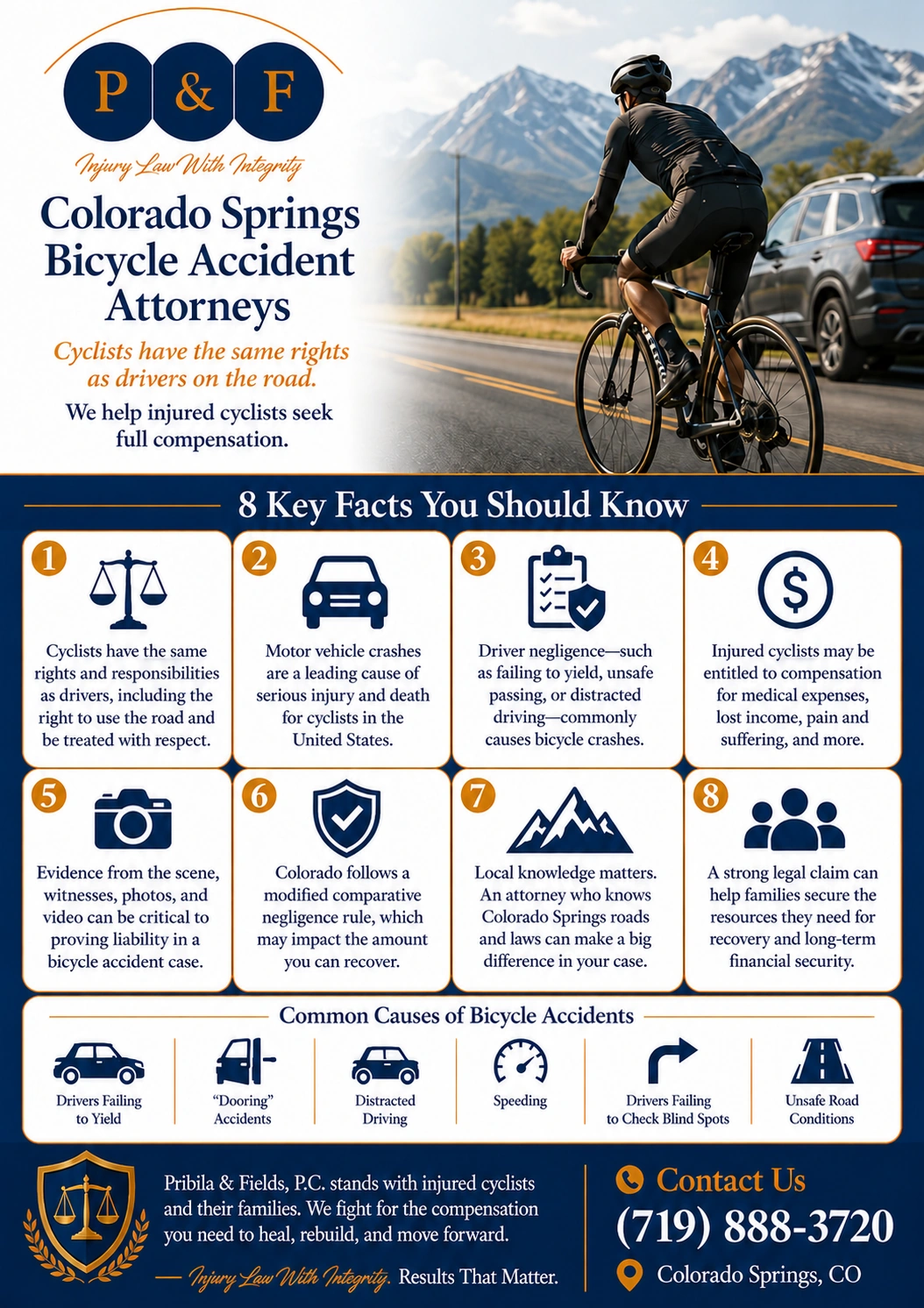
Bicycle-Accident-Attorney-Infographic

Frequently Asked Questions

Hiring an attorney after a bicycle accident in Colorado Springs is strongly advised, especially if you’ve sustained injuries or significant property damage. Insurance companies often try to settle claims quickly and for less than you deserve. An experienced attorney can help you navigate the claims process, communicate with insurers, and gather key evidence like witness statements and accident reports. Legal representation also ensures your rights are protected throughout the case. Additionally, attorneys can evaluate the full scope of your losses, including long-term medical needs or income disruption. With the right legal team, your chances of obtaining fair and full compensation significantly improve.
Victims of bicycle accidents in Colorado Springs may be entitled to several types of compensation. These can include reimbursement for medical bills, lost wages due to time off work, and expenses related to rehabilitation or therapy. Non-economic damages like pain and suffering or emotional distress may also be pursued. In cases involving egregious driver behavior, punitive damages may be awarded to penalize the responsible party. Each case is unique, so the value and type of compensation will depend on the evidence and severity of your injuries. Our experienced attorney will work to identify all recoverable damages and pursue the maximum amount under Colorado law.
The deadline depends on the claim. Colorado generally allows three years after a claim accrues for bodily injury arising from the use or operation of a motor vehicle. Other negligence claims generally have a two-year deadline. When the Colorado Governmental Immunity Act notice provision applies, written notice generally must be filed with the proper recipient within 182 days after discovery of the injury. This notice is separate from the lawsuit deadline. Exceptions can apply, so have an attorney identify the deadlines for your specific case promptly.
Colorado’s Safety Stop allows bicyclists to treat stop signs as yield signs and red lights as stop signs under defined conditions. If a cyclist complies with the law and proceeds safely, that can support the cyclist’s position on liability. Conversely, failing to yield when required can reduce recovery under comparative negligence rules. Police reports and signal timing data help determine whether the Safety Stop was used properly. Witness statements and onboard camera footage can clarify right-of-way decisions. Your attorney will apply the statute to show you rode lawfully and predictably.
Drivers must allow at least a safe passing distance when overtaking, and Colorado guidance specifies a minimum of three feet. Opening a vehicle door into moving traffic is prohibited unless it is safe and does not interfere with other traffic. Violations of either rule often provide strong evidence of driver negligence. Crash reconstruction can measure lane widths and passing paths to show the clearance was insufficient. Photos of door positions and hinge damage can support a dooring claim. These statutes help your lawyer prove fault when drivers crowd or door cyclists.
UM/UIM coverage from your own auto policy can cover you while riding a bicycle if a driver is uninsured, underinsured, or unidentified. You may also have MedPay benefits that pay initial medical bills regardless of fault. These first-party coverages can bridge the gap while liability is investigated. Your attorney will help open claims promptly and coordinate benefits to reduce bills. Keep receipts and medical records to document losses for both UM/UIM and liability claims. Using these coverages strategically can stabilize your finances and care after a crash.
In 2026, bicycle crash cases often benefit from digital proof that shows your route, speed, and the moment the crash occurred. Save your cycling computer or smartwatch files, app exports, and any helmet-camera footage in original form without editing. If the crash involved a vehicle, capturing the license plate, insurer information, and any dashcam or nearby business video can be crucial. Because comparative negligence can reduce recovery, digital data can help prove you were riding predictably and legally at the time of impact. Preserve your damaged bike and gear because impact points and component failures can also support reconstruction. In 2026, combining app data, scene photos, and medical records creates a stronger, more objective claim than relying on memory alone.
You may have a valid case if your bicycle accident was caused by a negligent driver, poor road conditions, or a defective bicycle component. Establishing fault requires investigating the details of the crash, including police reports, medical records, and eyewitness accounts. If you experienced injuries, financial loss, or emotional trauma from the accident, you could be entitled to compensation. Even if you're unsure who was at fault, a legal consultation can clarify your options. Colorado follows comparative fault rules, so partial liability doesn’t necessarily bar recovery. The best way to determine your options is to reach out us for a free consultation.

Additional Information in Colorado Springs

ColoBikeLaw - Colorado Bike Law: Detailed overview of bicycle-related laws in Colorado, including legal rights and responsibilities of cyclists under state statutes. It breaks down key rules, such as lane positioning, passing requirements, helmet regulations, and when cyclists must yield. The page is curated by a Colorado-based bicycle law attorney, making it especially relevant for local legal matters. It also highlights how state law treats bicycles as vehicles, granting them most of the same rights and obligations as motorists. For accident cases, this site helps establish whether traffic laws were followed or violated by either party. It can provide strong legal grounding to demonstrate cyclist compliance or motorist fault in litigation.
Colorado Department of Transportation - Bike Efficiency: Focuses on practical safety tips and riding techniques for cyclists. It covers topics like braking, gear use, body positioning, and energy efficiency to promote safe riding. The page also includes visibility and road-sharing advice for navigating traffic safely. Understanding and applying these tips can help show that a cyclist took reasonable precautions to avoid an accident. In legal cases, demonstrating that the rider followed CDOT-recommended practices can counter claims of negligence or recklessness. It also illustrates how infrastructure and awareness influence cyclist behavior and potential liability.
The League of American Bicyclist: Nonprofit organization advocates for cyclists’ rights, education, and safer infrastructure across the U.S. The site provides legal resources, state-by-state policy comparisons, crash prevention guides, and educational programs like “Smart Cycling.” It also maintains the Bicycle Friendly America program, which evaluates cities based on their bike-friendliness and safety measures. Legal professionals and accident victims can reference its best practice standards when evaluating city infrastructure or cyclist behavior. It strengthens cases by showing how Colorado Springs measures up to national safety benchmarks. Additionally, citing its recommendations may highlight gaps in road design or policy that contributed to the accident.
We're here to help you get justice & our friendly, qualified attorneys can help you pursue your claim & get the compensation you deserve.

schedule your free consultation

Please give us your preferred date and time for your Free Consultation. We do not believe in screeners or intake specialists. An Attorney will call you to verify availability.

Pribila and Fields, P.C. has successfully handled thousands of personal injury cases and tried scores of cases where an insurance carrier refused to pay fair compensation for injuries, losses or damages.

contact us

18 E. Monument Street
Colorado Springs, CO 80903
reception@pribila.com

Phone: (719) 888-3720
Fax: (719) 473-2542

The information provided on this website is offered purely for informational purposes. It is not intended to create or promote an attorney-client relationship and does not constitute and should not be relied upon as legal advice. It is not intended to seek professional employment in any state where lawyers in the firm are not admitted to practice, or in any state where this website would not comply with applicable requirements concerning advertisements and solicitations.

Powered by:

Epic Web Results text logo
chevron-down
linkedin facebook pinterest youtube rss twitter instagram facebook-blank rss-blank linkedin-blank pinterest youtube twitter instagram