(719) 888-3720

Colorado Springs Pedestrian Accident Lawyer

Colorado Springs Pedestrian Accident Lawyer

If a driver hit you while you were walking in Colorado Springs, your claim may involve medical bills, missed work and a dispute over who had the right of way. Pribila and Fields helps injured pedestrians document the crash, identify available insurance and pursue compensation. Preserve scene photos, witness details and medical records so an attorney can evaluate what happened.

Get help with your pedestrian injury claim. Call (719) 888-3720 or request a free consultation with a Pribila & Fields attorney.

 
Our published case results include a $350,000 pedestrian-hit-by-car result. This is one example of a pedestrian matter our firm has handled. Every case depends on its own facts; past results do not guarantee a similar outcome.
 

What Is a Pedestrian Accident and How Do They Happen?

A pedestrian accident is any incident where a person walking on foot is struck or injured by a vehicle, including cars, trucks, buses, motorcycles, scooters, or even bicycles. Unlike drivers or passengers inside a vehicle, pedestrians have no physical protection in a collision, making them extremely vulnerable to severe or even fatal injuries.
 
In Colorado Springs, pedestrian accidents occur in a variety of environments, from quiet residential streets to busy intersections downtown. These accidents are not limited to crosswalks; pedestrians may be hit while walking along road shoulders, traversing parking lots, or entering/exiting stores, schools, or workplaces.
 

Common Causes of Pedestrian Accidents in Colorado Springs

Understanding how and why pedestrian accidents occur can help residents stay safer on the road and ensure that those at fault are held accountable. The following are some of the most common causes of pedestrian accidents in Colorado Springs:
  • Drivers Failing to Yield at Crosswalks: Colorado law requires drivers to yield the right of way to pedestrians in marked and unmarked crosswalks. Yet many drivers in Colorado Springs rush through intersections, ignore pedestrian signals, or stop only partially, creating highly dangerous situations.
  • Distracted Driving: Texting, adjusting music, or checking GPS directions while behind the wheel diverts a driver's attention. In Colorado Springs’ denser neighborhoods and commercial corridors, a split second of distraction can mean disaster for pedestrians.
  • Speeding in Residential or School Zones: Excessive speed leaves a driver less time to react to someone crossing the street. In a claim involving a residential street or school zone, preserve the posted speed limit, school-zone signs and any evidence of the vehicle’s speed.
  • Driving Under the Influence: Driving under the influence of alcohol or drugs is a persistent and deadly problem throughout Colorado Springs. Impaired drivers have reduced reaction times and poor judgment, making them far more likely to strike a pedestrian.
  • Poor Visibility: Darkness, weather, glare and obstructions can affect whether a driver could see a pedestrian. Scene photographs should capture the lighting and sight lines as they existed at the time of the collision.
  • Failure to Obey Traffic Signals or Stop Signs: A driver running a red light or failing to stop can put pedestrians in danger. Signal timing, traffic-camera footage and witness accounts may help establish what each person was permitted to do before the collision.
The details of the crossing matter more than a general description of a neighborhood. Save the exact location, direction of travel, traffic signals and photographs of any obstruction before conditions change.
 

Locations and Evidence in Colorado Springs Pedestrian Crashes

Pedestrian crashes can happen at intersections, driveways, parking lots and residential crossings. The city’s public crash data can help identify recorded incidents at a specific location. For an individual claim, the important questions are where the impact occurred, what traffic controls applied and what the driver and pedestrian could see.
 

Road and Crossing Conditions to Investigate

1. Downtown Colorado Springs

For a downtown collision, document the nearest intersection, the crossing location, the vehicle’s turning movement and any parked vehicle that obstructed the view. Nearby business cameras may have recorded the approach to the impact.
  • Nighttime Visibility: Record the time of the crash and whether streetlights, headlights or glare affected visibility.
  • Witness Availability: Preserve witness contact details before people leave the area, including visitors who may be difficult to reach later.

2. Near Schools and Parks

For a crash near a school, park or college, photograph the applicable crosswalk, traffic signal, warning signs and any school-zone speed limit. Record where the pedestrian entered the roadway and the direction the vehicle approached.
  • Children at Risk: Young children often don’t fully understand traffic dangers, making school zones especially vulnerable.
  • Limited Crossing Infrastructure: Document the crossing controls actually present, including pedestrian signals, curb ramps and marked crosswalks.

3. Academy Boulevard

For a collision on Academy Boulevard, identify the exact intersection or driveway rather than relying on the road name alone. The number of lanes, turning movements, crossing controls and sight lines can all matter when reconstructing the crash.
  • Wide Roadways: Multiple lanes can confuse or trap slower pedestrians in the middle of the street.
  • Commercial Density: Record whether the vehicle entered or exited a business driveway and whether signs, landscaping or parked vehicles obstructed either person’s view.

4. Cimarron Street and I-25 Interchange

For a crash near Cimarron Street and I-25, preserve the precise ramp, crossing or intersection involved. Photographs of the approach, signals and pedestrian route help distinguish the conditions at that location from other parts of the interchange.
  • Frequent Lane Changes: Identify the vehicle’s lane and any lane change immediately before impact using video, witness accounts and physical evidence.
  • Poor Lighting: Preserve photographs showing the lighting and pedestrian access at the actual crash location and time.

5. Residential Neighborhoods

On a residential street, document driveways, sidewalks, parked vehicles and the point where the pedestrian entered the roadway. These details can help explain a backing collision or a dispute about whether a person was visible to the driver.
  • Speeding: Record the posted limit and preserve any available evidence of speed.
  • Reversing Vehicles: Backing out of driveways without checking for sidewalk traffic is a common cause of residential pedestrian injuries.
The crash location is a starting point for an investigation, not a substitute for evidence about fault. Our attorneys can review the available records and explain which facts matter to your pedestrian injury claim.
 

Common Injuries in Colorado Springs Pedestrian Accidents

Pedestrians have little physical protection when struck by a vehicle. Possible injuries include:
  • Traumatic Brain Injuries (TBI): Head injuries can cause memory loss, confusion, cognitive decline, or permanent disability.
  • Spinal Cord Injuries: These may result in partial or complete paralysis and often require lifelong care.
  • Broken Bones and Fractures: Victims commonly suffer shattered limbs, pelvis fractures, and rib injuries.
  • Internal Bleeding and Organ Damage: High-impact collisions can cause internal trauma, which may not be immediately visible.
  • Lacerations and Road Rash: Deep cuts and abrasions can cause permanent scarring and require skin grafts or plastic surgery.
  • Psychological Injuries: Anxiety, depression, and post-traumatic stress disorder (PTSD) are frequent among pedestrian accident victims.
Pedestrians in Colorado Springs deserve protection. When a driver’s negligence causes life-changing, catastrophic injuries, our attorneys fight to ensure victims are treated with dignity and compensated fairly.
 

Who Can Be Liable in a Colorado Springs Pedestrian Accident?

Determining liability in a pedestrian accident case in Colorado Springs requires a thorough investigation. While the driver is often at fault, there may be multiple responsible parties depending on the circumstances.
 

Potentially liable parties include:

  • The driver: If they were distracted, speeding, intoxicated, or failed to yield.
  • The vehicle owner: In some cases, a separate legal basis, such as a qualifying family-car claim, can make an owner responsible for another driver's negligence. The owner's relationship to the driver, control and permission require investigation.
  • Employers: If the accident involved a commercial vehicle or on-duty driver.
  • Local government or property owners: If poor roadway design, broken traffic signals, or lack of crosswalks contributed to the accident.
  • Manufacturers: If a vehicle defect caused the crash (e.g., brake failure, acceleration issues).
In Colorado Springs, local ordinances and state laws governing right-of-way, marked crosswalks, and traffic signal compliance are crucial in establishing fault. An experienced Colorado Springs pedestrian accident lawyer can gather the necessary evidence, such as police reports, surveillance footage, and witness statements, to build a strong case on your behalf.

Related: When Do Pedestrians Have the Right of Way in Colorado?

How Can an Attorney Help After a Pedestrian Accident?

After a pedestrian accident in Colorado Springs, you may be entitled to significant compensation, but getting it isn’t exactly easy. Insurance companies often try to shift blame onto the pedestrian or offer low settlements that don’t begin to cover the costs of recovery. That’s where a skilled attorney comes in.
At Pribila and Fields, our Colorado Springs pedestrian accident attorneys can help by:
  • Investigating the accident thoroughly
  • Identifying all sources of liability
  • Gathering medical records and documentation of damages
  • Negotiating with insurance companies on your behalf
  • Filing a personal injury lawsuit if a fair settlement can’t be reached
 
What compensation may be available after a pedestrian accident in Colorado Springs?

What Compensation May Be Available After a Pedestrian Accident in Colorado Springs?

A pedestrian accident can cause serious financial, physical, and emotional setbacks, especially when the victim is left with long-term injuries or unable to return to work. If you were hit by a vehicle in Colorado Springs, you may be entitled to pursue financial compensation through a personal injury claim or lawsuit. This compensation is intended to help you rebuild your life and hold the negligent party accountable.
 
At Pribila and Fields, our Colorado Springs pedestrian accident attorneys fight to recover full and fair compensation for all categories of loss, including economic, non-economic, and, when applicable, wrongful death damages.
 
You may be eligible to recover compensation for:

Medical Expenses

Medical costs after a pedestrian accident in Colorado Springs can be overwhelming. A single emergency room visit can result in thousands of dollars in bills, not to mention follow-up care, surgery, or long-term rehabilitation.
  • Immediate expenses may include ambulance fees, trauma care, X-rays, MRIs, and emergency surgery.
  • Ongoing care may involve physical therapy, occupational therapy, follow-up appointments, orthopedic equipment, or home modifications (such as wheelchair ramps or hospital beds).
  • Future medical needs are also compensable if your injuries require prolonged or lifelong care.
Our legal team works closely with your medical providers and experts to estimate both current and future healthcare costs so that you are not left paying out-of-pocket later on.

Lost Wages and Loss of Future Earning Capacity

If your injuries prevent you from working, either temporarily or permanently, you may be entitled to compensation for the wages you’ve already lost and the income you’re expected to lose in the future.
  • Many Colorado Springs residents work physically demanding jobs, and even a moderate injury could make it impossible to return to the same line of work.
  • Severe injuries like spinal trauma or brain injuries can lead to full disability, eliminating earning potential altogether.
We help calculate your current lost income and use vocational experts or economic analysts to estimate your future loss of earning capacity.

Pain and Suffering

Pain and suffering is a type of non-economic damage that accounts for the physical pain you’ve endured due to your injuries.
  • Whether it's broken bones, chronic back pain, or the pain of surgical recovery, these injuries affect your quality of life.
  • In Colorado Springs, victims of pedestrian accidents often face prolonged physical recovery due to the severity of vehicle-on-pedestrian collisions.
This category of compensation ensures that your day-to-day struggles are acknowledged because the pain doesn’t stop when the medical bills are paid.

Mental Anguish and Emotional Distress

Pedestrian accidents often leave lasting psychological scars in addition to physical injuries.
  • You may experience anxiety, post-traumatic stress disorder (PTSD), depression, or sleep disturbances following the incident.
  • Survivors sometimes avoid walking in public or crossing streets, impacting their sense of independence and mobility.
We work with mental health professionals to document the full emotional impact of your accident so it can be properly factored into your claim.

Permanent Disability or Disfigurement

If the accident caused amputation, scarring, burns, or permanent damage to your mobility or appearance, you are entitled to additional compensation.
  • Many Colorado Springs pedestrian accident victims suffer injuries that will affect them for the rest of their lives.
  • Disfigurement damages reflect the physical alteration of your appearance and the emotional distress that comes with it.
This type of damage also considers the cost of prosthetics, reconstructive surgery, and adaptive equipment.

Loss of Enjoyment of Life

Sometimes the effects of a pedestrian accident go beyond physical pain and visible injuries.
  • If your injuries prevent you from participating in activities you once enjoyed, like hiking in Garden of the Gods, biking in Palmer Park, or playing with your children, you may be entitled to compensation for loss of enjoyment of life.
  • This is particularly relevant for active individuals who face long-term limitations due to someone else’s negligence.
This compensation recognizes that your life has changed not just physically, but emotionally and socially.

Wrongful Death Damages (If a Loved One Was Killed)

Tragically, some pedestrian accidents in Colorado Springs result in fatal injuries. If you lost a loved one due to another party’s negligence, you may be eligible to file a wrongful death claim on their behalf.
Wrongful death compensation may include:
  • Funeral and burial expenses
  • Medical expenses incurred prior to death
  • Loss of the deceased’s income and financial support
  • Loss of companionship, guidance, and emotional support
These cases are heart-wrenching and often complex, but Pribila and Fields stands ready to guide families through every step of the legal process with compassion and commitment.

Colorado Springs Statute of Limitations for Pedestrian Accident Claims

Colorado generally allows three years after a claim accrues for bodily injury arising from the use or operation of a motor vehicle. Other negligence claims generally have a two-year deadline. The correct period depends on the claim; exceptions and shorter notice requirements can apply. See C.R.S. §§ 13-80-101, 13-80-102 and 13-80-108.
  • When the Colorado Governmental Immunity Act notice provision applies to a potential public-entity or public-employee claim, written notice generally must be filed with the proper recipient within 182 days after discovery of the injury, even if every element of the claim is not yet known. This notice is separate from the deadline for starting a lawsuit. Public-entity involvement and the required recipient should be investigated promptly.
  • Delaying your claim, even if you believe your injuries are minor ,can hurt your ability to recover compensation later on.
This is why it's crucial to speak with a Colorado Springs pedestrian accident lawyer as soon as possible after your accident. Our team will ensure that all deadlines are met, evidence is preserved, and your claim is filed correctly and on time.
 
Our team is able to help with a wide range of personal injury cases, including:
If you or a loved one has been seriously injured in a Colorado Springs pedestrian accident, contact our office today and schedule a free consultation to discuss your case and learn how we can help you move forward. 
 

Contact Pribila and Fields After a Colorado Springs Pedestrian Accident

For a consultation, gather the crash location and date, photographs, witness details, any report number and your medical records. Use our consultation form to share your preferred date and time. An attorney will call to verify availability.
 
Our Colorado Springs pedestrian accident attorneys have the experience, resources, and local knowledge needed to take on negligent drivers, insurance companies, and even government entities. We offer free consultations, and you pay nothing unless we win your case.
 
Call us today at (719) 888-3720 or fill out our online contact form to schedule your free case review. Let Pribila and Fields be your trusted legal advocate in Colorado Springs. Come see how we can make a difference in your recovery.

Reviewed for legal accuracy by Bethany Pribila on September 25, 2026

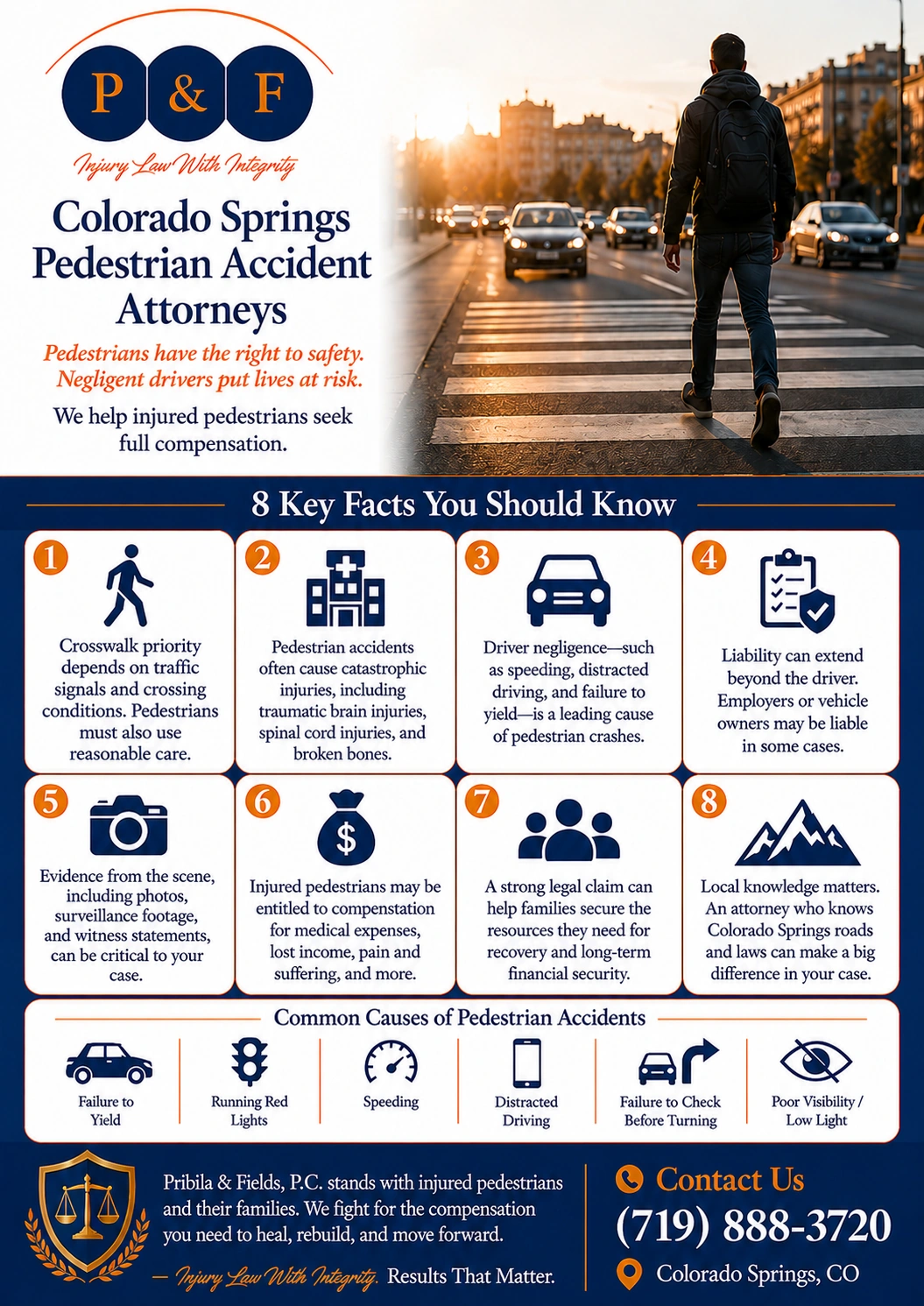
Pedestrian-Accident-Attorney-Infographic

Frequently Asked Questions

If you're involved in a pedestrian accident in Colorado Springs, your top priority should be seeking medical attention—even if you believe your injuries are minor. Documenting the scene with photos, gathering witness information, and filing a police report are essential steps. It’s also critical to avoid giving statements to insurance companies before consulting an experienced attorney. The right legal representation can help protect your rights and ensure you receive fair compensation for your injuries.
Fault in a pedestrian accident often depends on the specific circumstances of the incident. In Colorado Springs, drivers are frequently found at fault for failing to yield, speeding, or distracted driving. However, pedestrians may also share liability if they were jaywalking or not following traffic laws. Our experienced attorney can investigate the incident thoroughly and determine who was legally responsible under Colorado law.
Victims may be eligible for compensation that includes medical bills, lost income, pain and suffering, and rehabilitation costs. Depending on the severity of the case, emotional distress and long-term care may also be considered. In rare instances, punitive damages may apply if the driver acted with extreme recklessness. The amount awarded depends on the evidence and how well your damages are documented. Our legal team works to recover every dollar you’re entitled to.
Drivers must yield to pedestrians in marked and unmarked crosswalks when signals are not controlling. Passing a car stopped for someone in a crosswalk is prohibited and can establish driver fault. Pedestrians must still act prudently and not step into the path of a vehicle that is too close. Fault is often shared based on who violated the right-of-way rules at the moment of impact. Your attorney will analyze signage, signal timing, and sight lines to assign responsibility accurately. Understanding the crosswalk statute helps frame negotiations with insurers.
Colorado law requires drivers involved in injury crashes to stop, render aid, exchange information, and report the accident. Leaving the scene can lead to criminal consequences and strengthens the civil liability case. If the driver is unidentified or uninsured, your UM coverage can still pay for injuries. Pedestrians often qualify for UM/UIM through their own auto policy or a household member’s policy. Prompt reporting and documentation help your carrier process a UM claim. Your attorney will coordinate with law enforcement and your insurer to pursue every available source of recovery.
Yes, claims against public entities have a very short 182-day notice requirement. This notice is separate from the normal statute of limitations and must include specific information. Failing to provide timely notice can bar your claim even if you file suit later. Determining whether the city, county, or a transit agency is responsible requires quick investigation. Your attorney will identify the correct entity and deliver notice while gathering evidence. Do not wait, because missing this step can end the case.
In 2026, pedestrian claims often become fault disputes about crossing location, signal timing, and driver reaction time. Colorado’s comparative negligence law reduces damages in proportion to the injured person’s negligence, so evidence that clarifies right-of-way can directly affect recovery. You should preserve photos of the crosswalk, signals, lighting, skid marks, and sightlines, and request nearby surveillance video quickly. Save medical records from the first day forward, because early documentation helps connect the injury to the crash and reduces “pre-existing condition” arguments. If you have phone data that shows you were not distracted, preserving it can also help counter blame-shifting. In 2026, a time-stamped evidence package that covers both the scene and your medical timeline is often the fastest way to move an insurer from denial toward a fair offer.
If you’ve been hit by a vehicle while walking in Colorado Springs, you may have a valid pedestrian accident case—even if you’re unsure who was at fault. The best way to find out is to contact us for a free consultation. We’ll evaluate your situation, explain your legal rights, and let you know what steps to take next.

Additional Information in Colorado Springs

Colorado Department of Transportation – Bicycle and Pedestrian Program: Provides resources, policies, and safety initiatives related to walking and biking in Colorado. It outlines infrastructure projects, planning guides, and statewide safety campaigns designed to protect non-motorized road users. The site also includes maps, data reports, and information on funding programs that support pedestrian-friendly infrastructure. This resource is useful for understanding the legal and physical environment where the accident occurred. If poor infrastructure contributed to the incident, documentation from CDOT can help establish context or liability. In a legal case, this site can back claims that the area was known for safety concerns or lacked proper pedestrian facilities.
National Highway Traffic Safety Administration – Pedestrian Safety: Offers national data, safety tips, and educational materials focused on reducing pedestrian fatalities and injuries. It highlights common causes of pedestrian crashes, including driver negligence, alcohol involvement, and failure to yield. The site also provides statistics, public service campaigns, and enforcement guidelines for pedestrian safety laws. This information can help demonstrate how your accident aligns with national trends and known risk factors. If the driver in your case violated one of these common safety rules, referencing NHTSA data can strengthen your argument. Attorneys often use NHTSA findings to show the broader impact of negligent driving and support damage claims.
National Safety Council - Take Steps to Avoid Injury While Walking: Focuses on community safety efforts and personal responsibility tips for walkers and drivers alike. It emphasizes the importance of visibility, crosswalk use, and avoiding distractions for both pedestrians and motorists. The site also includes insights into injury prevention strategies and advocacy for safer road designs. For legal cases, this resource is helpful in demonstrating what a “reasonably careful” pedestrian or driver should do—potentially proving that the at-fault party acted irresponsibly. It may also support comparative negligence arguments if the defense claims partial blame lies with the pedestrian. NSC materials can add credibility to your case by citing respected safety guidelines and best practices.
We're here to help you get justice & our friendly, qualified attorneys can help you pursue your claim & get the compensation you deserve.

schedule your free consultation

Please give us your preferred date and time for your Free Consultation. We do not believe in screeners or intake specialists. An Attorney will call you to verify availability.

Pribila and Fields, P.C. has successfully handled thousands of personal injury cases and tried scores of cases where an insurance carrier refused to pay fair compensation for injuries, losses or damages.

contact us

18 E. Monument Street
Colorado Springs, CO 80903
reception@pribila.com

Phone: (719) 888-3720
Fax: (719) 473-2542

The information provided on this website is offered purely for informational purposes. It is not intended to create or promote an attorney-client relationship and does not constitute and should not be relied upon as legal advice. It is not intended to seek professional employment in any state where lawyers in the firm are not admitted to practice, or in any state where this website would not comply with applicable requirements concerning advertisements and solicitations.

Powered by:

Epic Web Results text logo
chevron-down
linkedin facebook pinterest youtube rss twitter instagram facebook-blank rss-blank linkedin-blank pinterest youtube twitter instagram